March Madness – Minnesota’s tournament blizzards
It’s now late March, the Girls Basketball tournament just finished in Minneapolis while a major snowstorm has begun crawling across southern Minnesota where I grew up. These blizzards often come in just after a prolonged thaw, when most of the snow is gone. The storms often begin warm and wet, with lightning and thunder before they dump heavy snow with lightning. Snow comes down on a driving wind that piles up drifts four-five-six feet high. March snowstorms aren’t rare—they’re normal—yet there is something especially wonderful about them. They’re massive and unpredictable.

During my childhood, the weather reports were general—at best. An accurate forecast in the 1950s came out in phrases like: “Scattered showers are possible across southern Minnesota,” or “There’s a chance of snow tonight with strong northwest winds.” That was about as close as a forecast came to what actually happened. Weather satellites, Doppler radar, and climate models added more detail but uncertainty remains.

Farmers I knew didn’t rely on the Farmer’s Almanac—only town people mentioned it. When it came to the weather, everyone was his own forecaster, and pretty much took his bearings from things we all understood—the temperature, the smell of the wind (did it smell damp), the kinds of clouds, the wind direction, whether the velocity was rising or dying, and whether the clouds moved with, against, or across the wind.

For a ten-year-old like me, the weather was a great mystery, a powerful force living just over the horizon. In the spring of my tenth year, we had a string of blizzards that began in February and ended near the end of March. Snow blocked our county road and driveway for several days each week before the county plow got through.

By the time the road opened, the forecasters were hinting at more snow in a few days. We hurried to town in the pick-up to buy groceries and anything else we needed—just in case. The next morning, I waited at the top of our driveway for the school bus. The temperature hovered at freezing and the damp air and south wind foretold approaching weather. School let out right after lunch the next day as heavy snow fell. Our bus slipped and skidded slowly along the roads, dropping off students who almost immediately vanished from sight in the swirling flakes.

All night, the wind howled in the treetops, the thermometer held steady at 32° F, and wind-driven snowflakes hissed against the window panes. I woke up in the morning confident ‘they’ wouldn’t cancel school. Mom turned on the radio at breakfast. In those days, we listened to WCCO, the CBS A.M. radio out of Minneapolis-St. Paul. Over Rice Krispies and toast, I listened eagerly to hear the announcer mention ‘Janesville’ on the list of closed schools. Another day to read pulp western novels.

Weekly blizzards continued until late March and each one kept us snowed in for several days at a time.  I missed about half of the school days that month, not that I cared. Drifts piled up, and one across our driveway stood at least six feet high. By mid-March, the snow was too deep for Dad to clear the driveway with the Ford tractor and scoop. He called a man with a bulldozer and the ‘Cat’ worked hard to push back the dense drifts—until the next blizzard closed the road and driveway five days later.

Like Paul Bunyan, these spring blizzards have gained legendary status among Minnesotans. They roar in from the Great Plains about the time high school teams assemble in Minneapolis-St. Paul for the state basketball tournament. Sometimes the teams had to stay a day or two extra before the roads opened. It didn’t take long for Minnesotans to connect basketball tournaments and spring blizzards.

While snow falls in Minnesota, I write this from southern Mexico, and feel the excitement of my ten-year-old self once more. For a day, at least, I wish myself back at the farm, feeling secure inside the old house, and watching the thick veil of blowing snow obscure my view of the woods along the river. In a day or two, the sun will eat up the drifts, and then spring will come, and March madness will end.


Response to the Daily Post–Price

A rug tienda in Mitla

Some people know the price of everything and the value of nothing. We’ve all met them—crabbed creatures with small hearts whose concept of reality is limited to accounts expressed as debits and margins of profit. Lamentably, we are all infected to a degree and fail to distinguish value from price.

Here, in Oaxaca, artisan goods are plentiful and, except for high end shops in the city center, they lack price tags. A buyer must ask how much, “¿Cuanto cuesto?” Asking is a good thing for a curious buyer because it may lead to a conversation, possibly an education, if not a form of fleeting friendship.

Pasale,” the weaver says, inviting me to enter his tienda or shop to look at his rugs or tapetes. Most artisans sell directly from their tallers or workshops with a stall at the weekly tianguis or market, and occasionally at the periodic ferias or fairs held at public celebrations, such as during Holy Week.

Zapotec rug motif
Zapotec rug motif

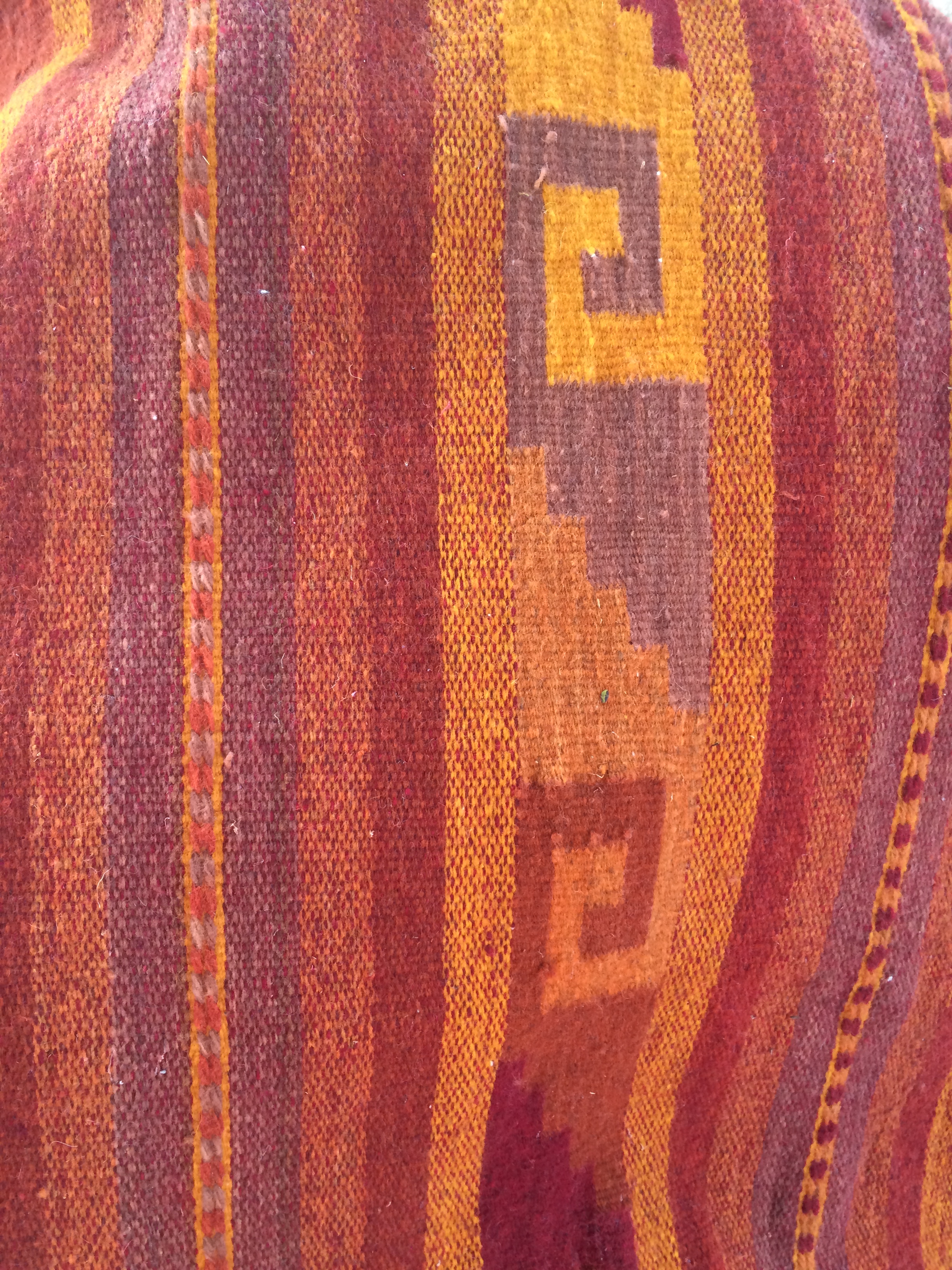
He is an engaging man in his forties with an open expression and easy way of speaking. Although I’m not in the market for a tapete, I pause and admire his work out of respect for his craft. This tienda is ablaze with rugs in brilliant colors—crimson, cinnamon, chocolate, gold, black, blue—woven into the Zapotec motifs of the indigenous people resident for millennia in this part of Mexico.

Me encanta los colores, modelos y diseños. Muy hermosos.” I tell him I love the beautiful colors and designs of his work. He smiles. I’m not in the market to buy one, I tell him, because I already have many in my house. But I admire your work. There are no other customers at the moment and he is happy to talk.

Esta es nuestra herencia, de generación a generación.” He tells me weaving is his family’s heritage. He learned from his parents and grandparents and now teaches his children to weave. Like most weaving families, they memorize their designs and motifs; there are no patterns in books. This is innate knowledge they pass on to succeeding generations much like families pass down to daughters and new brides the treasured recipes of the grandmothers. Recipes explain how to make a cake, but a family recipe is about a cake that transmits traditions as part of the family identity. And so it is with weaving. It’s more than a skill, it’s an identity.

Weaver's yarn-natural dye
Weaver’s yarn-natural dye

As a family, he and the children card, spin and dye the wool, and then work the telar or loom to produce tapetes, table runners, bedcovers, shoulder bags, and coasters. Weaving has a small margin of profit, he says, and the tourist market is always uncertain. Sometimes he sells only one or two tapetes a month, at other times more.

Why do this if the margin is so small, I ask.

Me encanta telar.” I love to weave, he says with a smile that comes from deep satisfaction. Despite narrow, uncertain profits, and hard, meticulous work, it is a labor of love, an essential part of his identity as a man, a resident of Teotitlán, and as a Zapotec with a language and culture extending back several thousand years. Even through the veil of Spanish, his and my second language, I hear his pride, authenticity, and love of creative work. In these intangibles of heart and soul, family and tradition lie the fuller value of the tapete, the rug some discerning tourist may buy as cheaply as possible to hang on her wall. It’s the love and dedication represents the full value of his work.

I ask if his price includes compensation for the time spent making the tapete. It doesn’t, he says, shaking his head, his expression wistful. This is true for all the artisans of tapetes, camisas or shirts, and faldas bordadas or embroidered dresses, rebozos, carvings, and other items. It is true of painters as well. The rug spring from a love of the labor more than mere financial gain.

The full cost of the tapete isn’t reflected in its price because the cost doesn’t account for the time spent making them, nor the accumulation of skill from years of practice and application. The cost includes the tangible materials, transportation, and other measurable items plus a margin above out-of-pocket costs in order to sustain the enterprise.

Embroidered madil or apron

How to put the true price on several thousand years of cultural life, the accumulated skill and wisdom in creating art like no other in the world? Any astute observer will quickly see the disconnect between the hidden cost of producing a tapete, its intrinsic value and its market price.  A five-by-seven foot tapete may take two months to produce and sell for $1,800 pesos or just over $100 dollars. To this yanqui, that’s inexpensive and a good buy—if I think only of the price.

But, after conversations with many artisans, it’s clear the value of what I want to buy is at odds with the price offered. This isn’t because the weaver is a poor businessman, it’s because art isn’t a commodity, each item is an individual work incompatible with ideas of piece-work and mass-production.

We who are buyers or “consumers” (how I hate that word!) of art, miss much of what we purchase when we concentrate on getting it for a lower cost. To some degree, we are all infected with a commercial perspective of wanting a bargain—of getting more for less if we can. We call this ‘thrift’ and tell ourselves it’s a virtue. However, most of us aren’t thrifty (look at our credit card debt) and our ‘thrift’ looks more like the cardinal sin of greed.

If the price is all we see, and the bargain is our ‘object,’ then we miss the intrinsic value of the object and—more importantly—we fail to see the human and cultural richness invested into the tapete. In that failure, we missing seeing something of ourselves in the lives, the hearts, the souls that produced the rug. As affluent buyers, generosity rather than ‘thrift’ becomes us. Paying full price, giving artisans a complement, a word of conversation, adds to their lives and enriches ours as well.