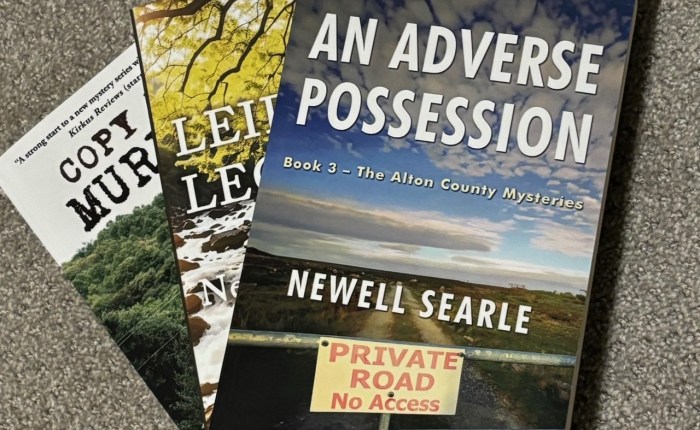
I am happy to announce the publication of AN ADVERSE POSSESION, the third novel in the Alton County Trilogy of mysteries available on Amazon or ordered from your bookstore. Dr. Robert Hartwell returns to Minnesota after years in San Francisco and finds the road to his mineral spring property gated and closed. Cattleman Justin Taylor claims the spring became his when he bought out an adjoining farmer who used Hartwell’s land. The farmer has moved and Hartwell’s lawyer asks Boston Meade to find him. What begins as a small favor becomes a manhunt where adverse possession embodies something more dangerous than Charolais bulls.
Chapter 1
An October rain beat a melancholy patter on the fallen leaves. In the dim light of daybreak, the three-story house loomed dark and angular against the cloudy sky but for a single light in a first-story window. Inside the house, Boston Meade shuffled a half-dozen clippings into a folder marked Runyon Mineral Spring ~ Adverse Possession.
He weighed the clippings in his hand and made a wry face. All I accomplished this summer. A few stories. Dozens of phone calls. Calls that led to more calls. More questions. Fewer answers.
He had readily agreed to help a lawyer find a recently retired farmer in a property dispute. A task of a day or two. After that, he intended to dedicate the summer to drafting a book about a retired forester when he wasn’t writing his syndicated column for American Outlook. Tracking the farmer took time away from the book and the summer’s writing consisted of a half-dozen articles for the Alton County Statesman, southeastern Minnesota’s largest daily. They were collaborations with Ginger O’Meara, the paper’s editor. Though he owned the newspaper, she controlled it because he hired her with a promise to keep his hands off its management. He paused and reread one of his articles:
WHEN YOUR PROPERTY ISN’T YOURS—Waterford—July 21, 1986.
Robert Hartwell, M.D., of Waterford claims his family has owned the Runyon mineral spring since 1874. According to Justin Taylor the spring became part of his cattle operation when he bought Norman Becker’s farm in May 1985. According to Mr. Taylor, Mr. Becker secured title to the mineral spring because of his continuous use of the tract for 30 years.
Acquiring legal title to another party’s property is possible under Minnesota law through open, continuous and unauthorized use for at least 15 years and spending money to improve it. The process is called adverse possession or squatter’s rights.
After selling his farm to Mr. Taylor, Mr. Becker left the county and his whereabouts are presently unknown. Dr. Hartwell and Mr. Taylor will present their documents of title in district court on July 28. Meanwhile, anyone with information about Mr. Becker’s current location is asked to contact the sheriff.
A brief, economical statement of the case, he thought. Well, most of it, anyway. Good as far as it went. He didn’t foresee what was coming. All his career, he tried to observe, connect and report the facts. Once he agreed to help Morris Isaacs, he couldn’t pretend to be objective. Undesirable but unavoidable. He couldn’t say ‘no’ so, after he said ‘yes,’ he couldn’t back out. Not after the disputed title turned into a case of probable fraud. He realized then he had become an integral part of the story.
He removed the tortoiseshell glasses, pinched the bridge of his Roman nose and then replaced the lenses. Shaking his head in disbelief, he marveled that a dispute over an obscure mineral spring thirty miles away could blow up into a story as complex as some of his international assignments in Saigon, Mexico City and Beirut. Once he got his teeth into this story, he spent all summer chasing it backward and forward in time until it played out.
What mysterious power draws men to a life on the sea or in the soil, he wondered. Not because there weren’t other kinds of work. Certainly not for the money. Farming was dirty, physical labor with great financial risks and damned small rewards. On top of that, the Bureau of Labor Statistics said four of the ten most dangerous jobs were in agriculture. It must be in their soul. Taylor was consumed by his dream of ecological grazing. Hartwell pursued his driving vision of a wellness center. Possessing a piece of land wasn’t like owning a car or even a house. Soil was a living thing and losing the farm brought endless heartache—like a divorce or the death of a child. It was existential. He knew families that had lost their farm after four generations. It was a mortal wound. No man owned a farm, the farm owned him. Boston knew he could say the same for journalism. Poor pay, some danger and a profession hard to quit. He rose from his chair and stretched. Quit bitching. I brought it on myself. No good deed goes unpunished.
He sealed the clippings into a manila envelope and put that into a folder between several others in the filing case. Then he shut the drawer with a feeling of completion. It was nearly 7:00 a.m. and time to make coffee. Then his phone rang. “Meade here,” he said in a soft voice. Then he held his breath as he listened to the caller’s brief message. “Thank you for calling,” he said softly and hung up the phone. Climbing the stairs, he whispered, “Death be not proud, for thou art not so.”
 R. Newell Searle