In this era of on-line sales, after more than a century as retailing behemoths, the business press predicts the imminent demise of Sears-Roebuck & Company and JC Penny. Both are institutions founded in an age before rural free delivery, widespread telephone use and, certainly, the internet. These mail order hosues were fixtures in thousands of small towns along with the Ben Franklin five and dime, Rexall Drug, A & W Root Beer stands and Dairy Queen.
 Growing up on a farm in the 1950’s, the Sears-Roebuck catalogue was definitely a “wish book.” With more than 500 pages, my sister and I would spend rainy afternoons pouring over the pages, selecting things we wanted but knew we couldn’t afford. One can dream. This catalogue was the Amazon.com of its day.
Every summer, Mom and I riffled through the catalogue, selecting the clothing for school in the fall and winter. I wore Roebuck jeans that didn’t have the same cachet as Levi’s. Of course, I had western-style shirts with pearl-like snaps instead of buttons. But no cowboy boots. Not practical, especially when my growth spurt started and shoe sizes expanded. Then it was my sister’s turn to pick her clothes. Before ordering, my sister and I stood straight as our mother measured our height, waist and chest to get the right size with room to grow during the year.
One of us carried the order in its envelope up the hill to the mailbox. Then we waited. And waited. And waited until the mailman blew his horn and dropped a box 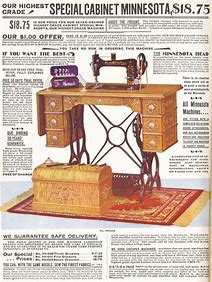 by the mailbox. Our clothes! The box was usually so big we had to fetch it in the pick-up. One by one, we took out the items. Ah, the aroma of new clothes. Then we tried on each item to be sure of the fit but we couldn’t wear anything until the first day of school. This was like an early Christmas!
You could buy anything from Sears & Roebuck—anything! The catalogue carried hardware, furniture, Kenmore appliances, Craftsman tools, sewing machines and even kits for houses. From 1908 until 1942, Sears sold pre-fab houses. The parts for the house were shipped in boxcars. Each house weighed up to 25 tons and contained more than 30,000 parts. Pre-fabs were cheaper to build and accommodated modern conveniences like central heating, electricity and plumbing. As I look at old catalogues (on-line) with pictures of the Sears houses, the designs look familiar and I wonder how many of those houses I have visited without knowing they were pre-fab? At least one house on a neighboring farm appears to a Sears house.
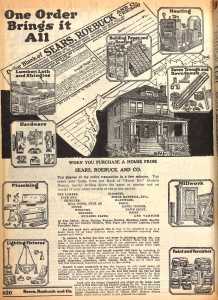 For many years, we didn’t buy a lot in the stores because it was cheaper to order goods from the Sears-Roebuck catalogue. We did it for the same reason we order books, clothing, cameras, yarn and household good from Amazon.
There is a cycle to this, I think. The Sears catalogue business offered rural residents an alternative to the narrower selection and higher priced goods of general stores. As the Sears business grew, and the population became more urbanized, it invested heavily in stores at shopping malls after World War II while its chief competitor, Montgomery Ward, did not. Sears continued to grow and diversify. It became the nation’s largest retailer until the 1980’s with the rise of Walmart. Since then, its fortunes have declined in the face of discounters. Now Target and Walmart are hard-pressed by competition from Amazon.
A Sears catalogue became archaic almost as soon as it left the press because the next wish book was in preparation. Many a catalogue ended its life in the little house with a crescent-moon on the door. Our neighbors didn’t have an indoor toilet until a decade after they bought a black and white television to watch wrasslin’ matches between Hardboiled Hagerty and Farmer Marlin. For toilet paper, they used last year’s Sears catalogue. A sad end to a volume of wishes. As I said, things go in cycles and maybe the antidote to Amazon will be the ‘buy local’ movement. Time will tell.
 Sound is something it’s easy to take for granted. Like the air I breathe, I take it for granted unless something stands out in the sound cloud around me. Then, maybe a noise I hear in isolation, triggers a memory. At once, the present moment dissolves, and I’m inside a past moment; it’s a spark of time as fresh and real as the original. These reverberations of the past never erode or rust or lose their power. They’re visceral, eidetic, and so penetrating that important parts of my life, my very soul, was shaped by them. It may be that my individuality and yours are defined as much by echoes as by fingerprints.
 You may laugh, but I will swear it is possible to hear corn growing. I know I did on humid, July nights, when no breezes stirred southern Minnesota. Lying in bed, I heard the faintest of sounds outside, as if someone were tearing paper slowly and carefully to make no noise at all. But something was ripping in the lower fields. It was the sound made by leaves of corn splitting their sheaths as they unfurled in the muggy darkness. It was a ‘green noise’ that often lulled me to sleep when nothing else could.
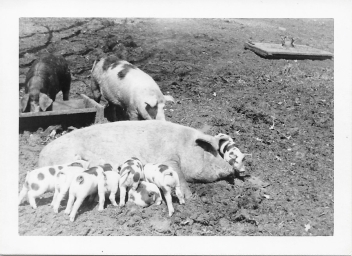 by a squeal. They usually fed at night, and took turns eating at the individual feed boxes covered with metal lids. In sixes and sevens, they nosed up the lids, then grunted contentedly as they smacked on ground oats and corn. When sated, each pulled his snout from the lid and it fell with a ‘clunk.’ Many nights, I fell asleep listening to grunt, smack-smack-smack, grunt. Clunk! This rhythm lasted until I left for college, and Dad sold the hogs. For a long time afterward, on visits home, I unconsciously listened for them and, when I didn’t hear them, knew a part of me was no longer resident there either.
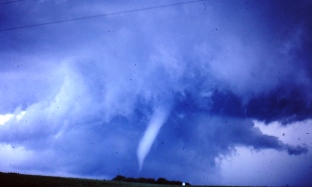 whispers ‘sweet nothings’ to leaves on a summer’s eve. Like great compositions, the wind may use a caesura, a full stop amid a storm, and in the fragment of silence, I can hear an individual drop of rain fall from a leaf and strike the ground with a fat ‘plop.’ The wind talks. For those who listen, there is much to be learned from the wind.
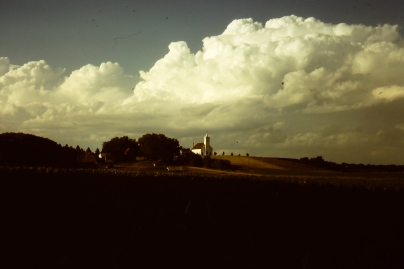 went to Mass. As the rural population thinned, the diocese closed the church, and it fell victim to time and neglect. I last saw it on a summer evening, shuttered but humming with the sound of bees swarming about a hole in its eaves. Only the cemetery remains but, somewhere in the heavens, the reverberations of that bell continue to ripple toward eternity.
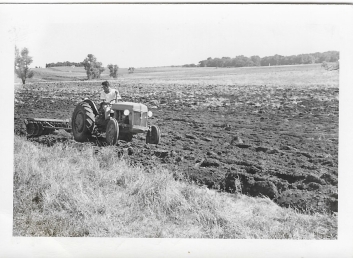 purred. Yet, despite the make of tractor, their sound faded quickly with distance. Some of my deepest memories are of twilight on spring evenings, hearing my father whistling Broadway show tunes as he tilled a field for planting. As sure as the sun came up in the east, I knew his restless soul was utterly content and he wanted nothing more than to make the brown, prairie soil ready for seed.


 R. Newell Searle