In response to The Daily Post’s writing prompt: “Pens and Pencils.”
Nothing fills me with greater joy and anticipation that finding a letter in my mailbox, the kind of letter addressed by hand in ink, bearing the return address of someone I know. These days I see fewer and fewer of such missives and I wonder what will happen to the art of writing with intimacy. What will happen to the tete-a-tete created solely for the eyes and heart of another person?
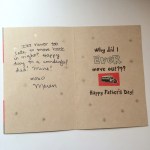
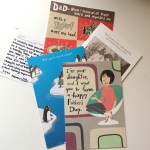
My daughters are now grown, one lives in California, the other in New York, and they communicate mainly by text, e-mail, and cell phone. Yet no message from them gives me as much pleasure as a birthday or Father’s Day card with a handwritten note, often silly, telling me how much they love me, and how happy they are I am a part of their lives. Although I wouldn’t doubt their love if they typed the messages, yet the expression would lack the intimacy, the personal touch of a hand holding a pen, a hand on an arm that is moving carefully to express what is beating in the heart.
As our family’s historian, I work my craft by reading other people’s mail. The oldest letter in our family collection dates from 1847. All are written in ink of various shades, some dark, some faded, laid on paper by different hands. Some of the family wrote with harsh, forward-leaning slants; others wrote with short rounded loops, and still others wrote stems on their letters that rose high and dove low. I have spent many evenings with these letters until I know each writer just by looking at their cursive.
Reading my parents’ letters written in New Jersey just before World War II, I know them anew from their penmanship, the length of the letters, and how quickly they answered them. Mail traveled faster in those days with twice-daily city deliveries. As young adults in love, they wrote constantly, feeling anguished when a letter wasn’t answered within a day.
My mother wrote personal, idiosyncratic letters that was repartee on paper. There isn’t much reportage of the ‘news’ as much as it was a conversation. Sometimes she laced her billets-doux with French phrases. A week after my mother and father met for the first time, she wrote a friendly note describing her ‘new cream gray 1940 Plymouth sedan’ and urged him to ‘come up soon and see it, if not me. I think we could have fun. Forget about the fact that I’m two years older than you are,’ she continued, ‘and you don’t bore me, so there!’ A year later, shortly before their engagement, she wrote what became a prophetic letter to my father while visiting in Minnesota: ‘Being out here is certainly wonderful and it’s really pretty in June. I’ve been thinking I’d like to move out here someday. Maybe I’ll buy a farm and adopt a couple of kids and just move in.’ Seven years later, we moved to a Minnesota farm.
Dad’s family, on the other hand, wrote letters reporting family ‘news’ the inverted paragraph style that read like the copy my grandfather edited as a newsman. These ‘family letters’, typed in quadruplicate with carbon paper, contain only ‘the news fit to print’ for a dispersed family. Even when grandfather wrote a personal letter, he typed it (his handwriting was illegible), much drained of any emotional content.
Among the oldest letters in our family are those written by Samuel Searl, my great-great-great grandfather, an itinerant Methodist minister and a farmer. Largely self-educated, he wrote well-turned phrases in a firm, flowing hand in dark blue ink. In his words I sometimes think I hear him in the pulpit; at other times I’m deeply moved by the intimacy of his letters to Herman, my great-grandfather, who was then a rebellious youth. He began by saying he wanted to devote ‘a few hours of leisure to another chat with you’, and asked Herman ‘what do you mean to do or mean to be, a man or a mouse, a knave or a fool, what heights does your imagination climb to?’ Writing to Herman’s mother, he commented on the boy’s photo, remarking – prophetically as it turned out – that his ‘countenance carries the mark of bold and daring speculations and enterprises that build high castles without climbing the hill of science’.
On my desk I keep a small, note written by my father during the last months of his life. His once strong, and distinctive cursive had shrunk to feebler characters bearing only a faint resemblance to the hand I have known for decades. He closed his short note with: ‘Like the color of this paper, I’m beginning to fade, too.’ His approaching death wasn’t news to any of us. We had talked about his prognosis many times and knew what he wanted. We all knew his death was a matter of a month or two. But the hand-written note, the scratchy lines written in an unsteady hand, spoke volumes and revealed my father’s spirits in ways that words alone couldn’t if written on a keyboard that would have all but wiped away his personality in his last month.
E-mail is a blessing, my Twitter account is interesting, I use Facebook to post pictures, but I feel no genuine emotions emanating from an emoji or thumbs up, or text shortcuts like LOL or OMG. None of these convey the heart of the person who sent them. They are too impersonal and the emotions behind them must be inferred. My point is: When we move away from the pen as the means of personal communication, we place an impersonal veil between us and the person we are reaching out to.
Letters are particularly human creations, and personal, hand-written letters are infused with a tender human quality. It is the tenderness of the heart flowing through the body to the arm, the hand, and finally to the pen as it moves across the paper. Putting pen to paper is to put our hearts on display. Each stroke of the pen reveals the writer; I reveal my personality, state of mind, and the sentiments in my heart that go beyond words. I know my correspondents by the kind of pen, the size of the nib or ballpoint, the type of paper, its color, and texture, and the style of their cursive. Pen and paper and ink are choices the writer makes, and they add detail and texture to how we know each other through letters. These physical characteristics of our correspondence are manifestations of ourselves. They are the human touch.
In response to The Daily Post’s writing prompt: “New.”
Before going to Mexico in October, I started a blog of my experiences rather than keep a journal. Instead of writing privately for myself, I posted my experiences and reflections publicly as if I were a ‘foreign correspondent’ to my readers. Every author loves to be read, and writing for others invites their reactions. Writers love readers’ comments just as actors and musicians live for the applause. The responses keep me going.
My blog – ‘Adventures in Midlife Spanish’ – is aimed at adults who dream about learning Spanish but believe it’s too late to start; that they’re too old to learn. I show them they can learn and offer practical suggestions to accelerate or encourage their learning. Language and culture are inseparable, and my posts reflect on aspects of Mexican culture from the standpoint of a norteamericano with a foot planted in the cultures on either side of the Río Grande.
While in Mexico, I wove together themes from the history, customs, and meaning of El Día de los Muertos or Day of the Dead, the celebration of Independence Day and its links to the on-going political protests, the role of the Virgin of Guadalupe in Mexican identity and a note of praise for the ubiquitous but essential tortilla. From Mexico it is easier to better understand my native culture when I see it from a new perspective. From there I am free to consider beliefs I haven’t questioned before.
After returning from Mexico, I started a second, concurrent blog called ‘Loose Leave Binder – Reflections on Thoughts, Words, and Deeds.’ The title reflects its looser, more eclectic themes. This is where I post pieces not related to learning Spanish or Mexican culture. It is a place where I can try out ideas and see what others think of them.
Now retired, I’ve returned to writing the way I’ve always wanted to write: To write for the pleasure of individual readers rather than to advance the causes of institutional employers. After thirty-five years of writing impersonal ‘white papers’ and ‘issue briefs’ for various corporate and government organizations, I’m free to write personally without an impersonal mask of dispassionate omniscience. Blogging invites a more immediate, spontaneous style of thinking and writing; it’s a style I had to re-learn in the place of habitual objectivity and self-censorship.
Words are like a mob of extroverts; once I put them down on the paper or screen, they immediately invite other words to associate with them. Then this gang of associated words take me to places I hadn’t thought of going to. That’s the thrill of writing, I don’t know what I’ll produce until I’m done. Blogs seem to write themselves and I’m simply a channel.
Blogging is my discipline. With every post, there are decisions to make that will shape my work. How often to post? What subjects to cover? Should I create a connected series or follow my whims? What is my ‘tone’ of voice – didactic, conversational, or meditative? These and other questions shape my writing, provide continuity, and set a standard against which I measure my work.
The joy of blogging is like going to a high school reunion; it’s a party where I encounter the English language again as I would a boyhood pal, we are new to each other, and yet, we are familiar with much to say.
Ice, water, and steam. Regardless of form, it remains H2O. That’s the nature of the universe: dynamic, changeable, and yet certain properties endure regardless of form or function. Matter forms and reforms, continually shaping and reshaping itself. Atoms and molecules flow into and out of each other. Creatures live linear lives yet within the cycle of seasons and phases, as in birth, life, and death. Nature abhors a vacuum and with it, stasis.
You and I shouldn’t be surprised to discover that we are at least chameleons if not shape-shifters; creatures who readily transform ourselves to meet new circumstances by adapting, mimicking, or conforming to others. It’s an inherent part of our emotional DNA; it’s how we survive as individuals and societies. We do this naturally, unconsciously, and every minute of the day as circumstances require. And yet, like water evaporating, condensing, precipitating, flowing, or freezing, we never lose our essential character. What the others see as ‘you’, are narrow facets of the greater being deep within you.
Ice: In its solid state, water can be locked in place for a long time. I started life with the illusion that I would be the person I willed myself to be; and it worked for a while. After a successful career as a public affairs professional, historian, author, and conservationist, I had a ‘reputation’ as a man of integrity; thoughtful and analytical but guarded and hard to know. I was who I thought I should be and worked hard to become. That’s the downside of success; being afraid to step outside our customary boundaries, fearful of losing our ‘identity’. Nothing is further from the truth. Only later did I learn that great changes and transformations are always possible. The processes are those of expansion and addition, not contraction and reduction.
Water: In its liquid state, water will take on the shape of whatever contains it. All life depends on this fluid state. As a Spanish language student in Mexico, I left behind the identity signified by my ‘reputation’ because it was irrelevant to my studies. Yet, I didn’t lose my identity. Liberated from the obligation of living up to the container of my ‘reputation’, I adapted, mimicked, and conformed to the people among whom I lived. Very quickly, I noticed a new aspect of my personality emerging, something long-dormant that germinated only after I entered the right environment. My guarded introversion became a more open extroversion, opinions trumped objectivity, and emotions overcame analysis. As my wife later observed: ‘You’re a different person in Mexico.’
Steam: In its gaseous state, water is a cloud, an evanescence, a possibility that can condense as dew, precipitate as rain, or freeze as snow. The future is a steam of unknown possibilities. When my father died last January, I became the elder in our extended family; the oldest of my siblings and first cousins. I’m the keeper of the family’s past, the one who knows its history. To be the eldest has less to do with my actual years than my place in the family. Death isn’t a stranger to me, but I feel more deeply now the shortness of time ahead. Ignoring my mortality was easier when Dad was living. No longer can I ignore the fact I might be next. I retired, my daughters have married and moved into adulthood, my granddaughter was born a few months before my father died. Few months, our family comprised four generations spanning 93 years; the full cycle of life and its possibilities.
Water changes form with the cycle of the seasons: Precipitating, flowing, evaporating, and freezing. My being changes with my location and company: Guarded professional, open traveler, family elder. I am these things and more. There is joy in the constant dissolution and reconstitution of my life, it is ever different and yet always the same. Nature abhors vacuums and stasis; that’s why we are shape-shifters.
Warmth, not heat, but warmth seems to define the human condition. I welcome warmth with anticipation for what the season brings and watch it depart with gratitude for its many gifts.
It’s the first spring-like day in early April, I quiver with the anticipation of lasting warmth. It feels like new love. Standing outside, under a clear sky, I turn my face to the bright sun. The air is calm and my jacket lies unneeded on the grass. I fill my lungs with the scent of the waking earth; I watch robins hop across the lawn, piping their cheery song. In my heart, I know there’s more warmth where this came from. And even if a few flurries and drizzles follow next week, I know I hold a ticket to winter’s last act. Real warmth is on its way.
All too soon it’s the end of October, and possibly it’s the last summer-like day of the year. Now the midday sun rolls closer to the horizon, shadows lie longer across the yard, and there’s frost in the morning. I shiver a little and take comfort in the jacket zipped to my neck. Here in the North, on the cusp of gray, stormy November, I dwell on the bumper crop of heirloom tomatoes, the happy sound of children running through the sprinkler, and the suntan I got without a bad burn. It might snow tomorrow, but I have a larder full of memories to carry me through the winter.
Warmth. Yes! But it’s the memories of warmth that sustain me in the coldest of seasons.
It is rare that I enter anyone’s house or office that I don’t immediately glance at the bookcase or the magazines on end tables. It’s a habit in homes and offices where I don’t know the people. Title by title, I try to extract a clue as to their interests, their tastes and, possibly, their character. It’s more than idle curiosity; it’s part of a ‘strategy’ for making a connection, establishing a rapport, and knowing what topics to avoid. I
I lived with a Mexican family when I studied Spanish. The first time I entered their home, it took only a minute or two to see the titles in their bookcases covered a wide range of art, culture, and history. I knew immediately we would have a lot in common. In time, our shared interests grew a deep and lasting friendship.
The contents of a bookcase are something unique if not personal, and may be as good as a curriculum vitae. Its quirky collections are as individual as a signature, and a quick study of titles may reveal its owner’s ideas, interests, and passions – a map of the soul. Now and then I come upon a bookcase stocked with new, leather bound books, for ‘show.’ I know they’re meant to impress me but pristine-looking books aren’t impressive, regardless of the authors. Worn covers and dog-eared pages, books leaning on each other, are the spoor of a serious reader.
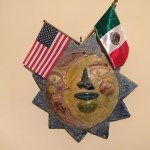
A large, ceramic disc of the sun hangs over my desk; a simple work by a Mexican artisan, something we brought back from Oaxaca years ago. There’s nothing out of the ordinary about it, just as there is nothing peculiar about other common objects in my study. But if you look closely, these things might tell you a lot about me.
The disc hangs on the wall of my den at a height where we look at each other – eye-to-eye – while I’m writing. Its taffy-colored face has a blue nose and lips, but the right side of the face is brown and shaped like a crescent moon with one eye. Uniting of the sun and the moon is a common motif in Mexican art. To it, I’ve tucked small American and Mexican flags, their staffs crossed behind a gap between one of the eleven triangular ‘rays’ surrounding the face.
The two flags are important to me. I’ve grown to love Mexico as I love the United States, but I love them for different reasons. Each culture has its great virtues and its tragic flaws; and at some level these virtues and flaws are complementary antidotes for what ails each country – if only their peoples can see it.
At some point, years ago, the disc broke, the break running from beneath the eye of the ‘sun’, then just under its nose and across the lower cheek of the ‘moon’. I don’t remember when or how the break occurred. The cause of the fracture, like the spark of a lovers’ quarrel, is lost to memory. But the line where it broke is as obvious as the Río Grande. It’s that way with many of life’s breaks and difficulties; the cause isn’t always remembered but the scar is visible.
Instead of throwing away disc, I restored a piece of the universe; gluing together the sun and the moon, the masculine and feminine faces of the cosmos. Now, like a couple after counseling, the breech is healed and the union is stronger than before. The still-married sun and moon, bedecked with Mexican and American flags, smile as I work beneath their gaze.
Behind me stands a tall, white bookcase from Ikea. The lower three shelves are filled with books, the upper two hold CDs and DVDs. Atop it are small wooden figures, fanciful animals, two elephants, a rhino, and a giraffe, playing musical instruments; produces of a Mexican artisan. The disc, the wooden animals, the bookcase, and its contents reflect if not describe me in ways I hadn’t considered.
The rows of books are segregated. On the very bottom are the larger, heavier books: a historical atlas of WWII, and a volume that accompanied Ken Burns’ film, The War, an encyclopedia of American history, How Fiction Works, Child’s History of Waseca County, and others, including a Rand-McNally road atlas. On the shelves above are paperback books on Mexico, anthologies of short stories written by Latin American authors, a study of Mexico’s presidents, bi-lingual Spanish/English stories, novels, and histories of Latin America.
The CDs are arranged somewhat by genre: Folk, country-western, Latin, Irish, jazz, classical. Within each genre are one or more favorite songs from certain times of my life. To say that only one song is my favorite is difficult if not impossible. That’s the rub. Each song occupies one of the many corners and phases of my life. To pick one song over another as a favorite is to diminish the other parts of my life in favor of another. But life is an indivisible whole; but certain songs encompass a defining moment, an era, an evening, a love, or a phase of my life. They’re part of my personal archeological record.
Listening to the Fleetwoods sing I’m Mr. Blue takes me back to high school dances and an innocent time with no clouds on the horizon. If I play a Duke Ellington recording of It Don’t Mean a Thing, I can see my parents dancing a little in the living room to the music of their generation. Strains of James Taylor singing Sweet Baby James carries me back to grad school in the ‘seventies and finishing my dissertation knowing I won’t be a history professor. As a corporate professional in the ‘eighties and ‘nineties, I escape that mode by listening wishfully to country-western music of Willie, Waylon, and the outlaws. On road trips with my daughters, they choose the music and I pick up the expenses. Now, when I head west, either alone or with one of my self-styled ‘roadies,’ I leave before daybreak to the strains of Willie Nelson singing On the Road Again. I play this when they aren’t with me, letting the melodies conjure up memories and something of their bright spirits.
More than music, it is language – books – that hold a special meaning. On my shelves are John Gerach’s Sex, Death and Fly-fishing, my father’s Minnesota Legislative Manual, Wallace Stegner’s Sound of Mountain Water, The Book of Common Prayer, autographed first editions Singing Wilderness by Sigurd Olson, Theodore Roosevelt’s Hunting Trips of a Ranchman, We by Charles Lindberg, and Canoeing With the Cree by Eric Severaid. There are many other books on writing, collections of stories and novels. It’s a collection of interests, a hodge-podge. But a bookcase with its contents is the invisible but emotional catalogue of our lives.
Whether music and language, certain songs and words are embedded in the eidetic memories at the center of our being. They are there, always. Songs and words sometimes define a present moment; and sometimes they take us back to a particular moment. And for me, there are times when I don’t know whether I am going forward or backward in my soul. Nor do I care, I enjoying the ride.
Yesterday’s news is stunning: Cuba and the United States are re-establishing full diplomatic relations. The newsman’s words are hard to take in at first. It’s as if the Earth’s poles have switched. It’s not the end of the embargo, and Congress can still shut the doors once more – at least for awhile – but it might be the beginning of the end of toxic relationship.
My first clear memory of Cuba was Castro’s Revolution, and then the tense days as a college student while Kennedy and Khrushchev glowered over missiles in Cuba. After that, Cuba vanished behind the silence of the U.S. embargo, but during the Viet Nam War, Che’s face popped up on T-shirts worn by the ideologically-minded students.
I visited Cuba exactly a year ago and this change seemed unlikely; change was a wisp of cloud along the sea’s far horizon. From e-mail posts, I know this is a cause for joy and anticipation among friends in Havana and in the little towns of Itabo, and Favorito. This is something they hoped and prayed for, yet they and we didn’t think possible. Now it is here.
What happens next depends on Congress. Some of the wannabe Republican presidential candidates are already huffing and puffing their opposition as they line up for 15 minutes of fame. I don’t expect them to speak or act on facts or rational thinking. An early sample of their partisan reactions tastes like the stale, set-phrases and the pre-approved gruel seasoned for their political bases. We’ve all heard these rants before; they’re the hollow echoes from the long-ago Cold War.
It is time for the self-serving cold warriors to put an end to an embargo that has inflicted suffering on the average Cuban. There is neither honor nor morality in starving a population in the hope they will overthrow the Castro brothers. It’s utterly cynical to expect Cubans to shed their blood ousting a regime we don’t like. America does its best when it deals with the world as it is, not as we wish it to be.
Cuba has been completely independent of direct U.S. interference for the first time in its history. Most Americans don’t know – or have forgotten – that the U.S. has dominated Cuba since President Thomas Jefferson tried to buy the island from Spain. Politicians from Southern states wanted to annex Cuba in order to expand the economic and political power of slaver holders. After our Civil War, American corporations set up shop in Cuba and controlled several economic sectors, beginning with sugar. And with the Americans came Jim Crow laws imposed on freed slaves.
In 1898, the United States went to war with Spain to protect American economic interests more than to help the Cuban insurgents. And when Spain and the U.S. made peace, Cuban nationalists weren’t party to the negotiations. Spain ceded Cuba to American protection and governance. Before granting Cuba independence, the U.S. imposed the ‘Platt Amendment’ onto the Cuban constitution granting the U.S. the right to intervene whenever it felt American interests were at risk.
Cubans deeply resented this provision and homegrown democracy never had a chance to flourish for long. The U.S. governed Cuba until 1902, intervened and governed it from 1906-09, then in 1912, and again from1917-1922. By 1926, U.S. interests dominated 60% of the Cuban economy. Democracy had a rocky road in the 1930s. Fulgencio Batista served as President from 1940-44, regained the Presidency in a 1954 coup, and ran a corrupt and repressive government allied with the U.S. until his ouster by Fidel Castro in 1959. This is the part of Cuban history we forget; this is the part of the history the Cubans remember, and it is still relevant today.
Che is dead and the Castro brothers are now old men. Since 2006, the slow, liberalizing economic initiatives of Rául Castro are tacit admissions that Fidel’s communism was a failure. My Cuban friends know this as well. Communism failed, socialism failed. It failed, in part, because Cuba’s economy relied on one product – sugar. But world diets changed, corn syrups replaced cane sugars and the subsidy from the Soviet Union is long gone. After a difficult “Special Period” in the 1990s, Cuba increased its food production through reforms and allowing farmers to sell their produce. Cuba is also developing ‘agro-ecology’ which is more climate resilient than monocultures. Despite the austerity of daily life, Cubans are an impressively hopeful, self-reliant people.
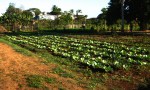
For several days over the 2013-2014 New Year, the group I led stayed in the small town of Itabo, living in a dorm owned by the local Anglican Church. The church owns land and grows food crops it sells to the town’s residents for a few pesos; and its fields also demonstrate to others the sustainable methods of agriculture.
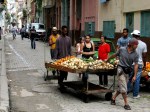
Havana vendors of locally grown vegetables.
BBQ on New Year’s Eve
Frederico tends the fields.
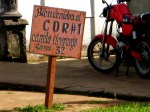
Welcome from the CDR, Defenders of Revolution.
Frederico and I become compañeros or friends over the details of raising food crops. Between his Cuban and my Mexican Spanish, he explains how they do sustainable agriculture. I also learn he was trained as a veterinarian, was drafted into the Army, and served in Cuba’s intervention in the Angolan civil war against the U.S. and South African interventions. It was an episode in his life, something he did decades ago, but he has no ideological bitterness toward the U.S.; he is happy tending the fields run by the Church. Material life is better now, he tells me, and he believes it will get better. He is a man of faith.
Tikito is a natural teacher. As we walk along the edge of a forest, he points out the types of trees and plants, all of them new to me. He explains things simply, and well, casually using guidance and affirmation rather than instruction to inform me. In fact, he trained to be a teacher, but teachers are government employees and salaries are low. Instead, he works as a carpenter, does projects and odd jobs, and makes more money. His humor is wry, even subversive, and he takes subtle jabs at ‘government’ but says the U.S. embargo, not the Castro brothers, are the biggest barrier to a better life in Cuba.
I go into the palapa, the open, thatch-roofed shelter to get out of the sun. One of the women working in the kitchen is there, taking her cigarette break. A small woman, with a wizened face, is funny, outspoken, and laughs with the husky voice of a heavy smoker. Do I like it in Itabo? she asks. Do I like Cuba? I tell her I like Cuba a lot.
“This is a good place,” she says of the village, home to several thousand people. “Nobody bothers us here. We’re free.”
Free! Here words surprise me. Free. What does that mean to her? Free. American notions of freedom include a long list of liberties guaranteed by the Constitution and laws. Cubans don’t have those – at least not now, and haven’t for a very long time – if ever. The office of the CRD – Committee for the Defense of the Revolution, the Communist Party – is just down the street. It’s supposed to keep an eye on un-revolutionary activity. We are free she says. What does free mean?
The day is New Year’s Eve and our group enjoys a barbeque of roast pork (killed that day) with hot, fresh, chicharón (deep-fried pigskin), rice and black beans (‘moros y cristianos’), lettuce from the fields, and beer. Afterward, the church leaders set up a soundboard and huge amps for the New Year’s dance. Dozens of people from the little town, church members and non-members, join our group, dancing as only Cubans can. The music from the amps probably reaches all corners of the town.
No one calls the police to complain of the ‘noise.’ People are free to play loud music in Cuba. It’s expected. Municipal noise ordinances generally prohibit playing loud music in Minnesota neighborhoods. We dance in groups, in lines, clapping and singing until the music stops at midnight. After a moment of silence, the amps pour out ‘The Star-Spangled Banner!’ We rise to our feet, put our hands over our hearts, and sing the familiar words as our eyes dart toward the street, wondering when the local Communist officials will show up. They don’t. national anthem is followed by the Cuban national hymn; we stand for that, our hands over our fast-beating hearts. Now it’s a few minutes into 2014 and the dancing resumes. We don’t know it yet, but 2014 is a ‘new’ year in both countries.
In the morning, I thank the leader for playing our national anthem. Then I add: “I hope that won’t get you into trouble with the officials.”
“No. No trouble. We were just showing respect for our guests,” he replies. Free.
There is no white-washing the atrocities of the Castro regime. Nor can we excuse those of the Batista dictatorship. Those are facts of history, a part of the fabric of Cuba’s past and, to a degree, a part of it is in the fabric of America’s history as well. And yet, despite nearly two centuries of economic domination and political interference by American interests; and the brutality of the Batista dictatorship and the Communist regime, and despite the material austerity of the last fifty-five years, Cubans are a warm, open, hopeful, and generous people – as individuals and as a society. Although owning little, they readily shared what little they had, but asked for nothing in return. Generosity is a freedom of the heart.
Yesterday’s announcement will slowly change the relationship between Cuba and the United States, and between Cubans and Americas as individuals. Cuban optimism and hope in the face of austerity and oppression are to be admired and, perhaps, emulated in a contemporary America that seems less open, less generous, and less hopeful than in its past. Perhaps we can learn from more contact with Cubans something about the freedom that comes from hope.










 R. Newell Searle