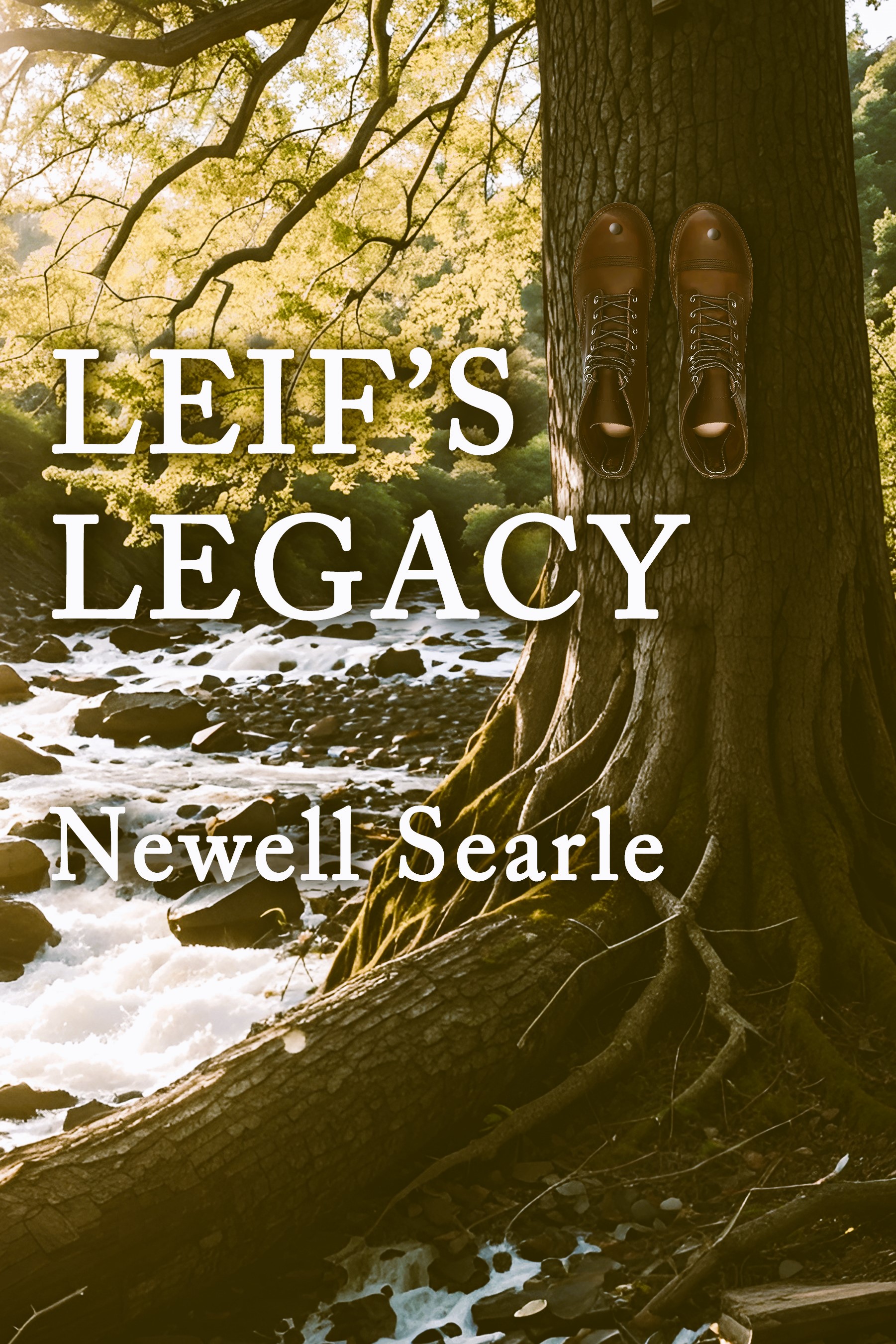
An excerpt from Leif’s Legacy by Newell Searle, the second novel in the Alton County mystery series. The retired forest ranger is a man of opinions shaped by observation and hard experience. In this selection, he reveals something of his inner life to Boston Meade during the newsman’s visit at his farmstead at Tarn Lake:
The forester interrupted this reminiscing, drew on his pipe and pointed at the sooty terns and tree swallows that darted after insects just above the water’s surface. “See them? Notice how plants and animals support each other. A place for everyone. All equal. That’s how I come to forestry,” he said. “Studying natural science will reveal more about God and his intentions than what’s in the Bible or Luther’s catechism. If you’re looking for revelation, it’s all around you… in the creation.” –Leif Nielsen
Nothing reveals a person’s character like an argument that lays bare the emotions and underlying values through the choice of words and gestures. An argument is primal and shows who we truly are.
As a writer, I use arguments as a way of allowing each person to describe or define themself by what they believe. In my forthcoming novel, Leif’s Legacy, the Nielsen brothers struggle over the future of the family homestead on a pristine lake. Leif, an elderly ex-forest ranger, owns the property and lives alone. He is hospitalized with pneumonia after making a field survey. Harald, his much younger brother, is a doctor whose idea of a good life differs from Leif’s:
Harald stood at the foot of the bed and looked him in the eye. “You’re better already,” he said in surprise and checked the charts. “That’s an incredible rebound. You can go home in a few days.”
“Good,” he grunted. “I don’t like it here.”
“You better take it easy from now on. You’re not a young buck anymore. No more camping.”
“We’ll see about that,” he snorted and then started coughing.
“Be serious,” Harald pleaded. “Think about how to live your last years. Think about what happens to the farm after you’re gone.”
“Why?” he asked, testily. “I’m not dying any time soon.”
“It could happen. You’re at a point where it isn’t safe to live alone.”
“The hell I can’t,” he bristled. “I’ll live there ‘til I die—and that ain’t soon. Hell, even sick I’m stronger than you.” He sat straighter to make his point. “A life without struggle isn’t worth much. When the day comes that I can’t… that’s when I pack it in. I’m not—”
“—Think about this. If you sold the farm, you could get enough to buy a place in town. You could have someone to cook and clean for you,” Harald said giving Leif’s leg a gentle pat. “Think it over. Be sensible. You’re pushing eighty and—”
“—And I’m old enough to know my mind,” he snapped. “God-damnit, I’m not going to let you shove me into to a compost bin you call a nursing home. Jeez-zus Key-ryst! You ought to know me better than that. I entered the world at the lake and by God that’s where I’ll leave it.”
“Easy. Don’t get all worked up. I’m sorry. I just don’t understand your attachment to that place. It’s an old house on a lonely lake.”
Can you think of an argument that defined you or someone you know? What did you learn?
All stories take place in both time and space. Intriguing stories employ a keen sense of place as an integral part of the story and more than a backdrop. It must be a place that the stories’ characters enter and leave, places that sustain and threaten them, places they identify with or that repel them to the point of flight. Because stories can carry us across time and space if they occur in a place we can touch and remember. A good story needs a geography of length and breadth and height, signs of settlement if not civilization past or present, a place where plants and rocks aren’t generic but named. And, if it is Minnesota, the place needs some kind of weather. Being specific about the elements of a place implicitly conveys things that need not be said. If the action occurs in a valley woodland of maple and basswood trees, readers may sense without being told it is a cool and shady place. Or, if it is on a hillside grown to oaks and hickories, the reader may sense it is dry with mottled shade. Specifics both limit and extend the action.
Kirkus Reviews gave Copy Desk Murders a coveted starred review for, among other things, “a fine sense of place.” In the fictional Alton County, each setting reflects a specific locale in southern Minnesota whose details I know well. And it is the specific details of these that affect what the story’s characters think and do. For example: The intern’s corpse lies at the bottom of a ravine. The serpentine road down that wooded coulee suggests several plausible causes of death and differences of opinion that will drive the story forward. This coulee is real and I travel down it to ready a trout stream. The city of Featherstone with its Romanesque core of red brick buildings is a composite of several towns in the region. Then I borrowed the real Louis Sullivan bank (National Register) from one of those cities and added details from others. Though I didn’t grow up in a three-story house on a hill, the landscape visible in the novel it is an expansion of what I often saw from our farmhouse porch:
Grandfather Meade built the house among the bur oaks at the end of a low, limestone ridge he dubbed San Juan Hill. From there, he saw most of Featherstone a mile to the east where the late afternoon sunlight gleamed from the water tower, courthouse dome, church spires and grain elevators. From east to west, his gaze took in the fencerows that divided southeastern Minnesota into fields of corn and soybeans, oats and pastures interspersed with groves and farmsteads. He could see for miles until the countryside dissolved into the haze at the horizon. At this evening hour, long shadows stretched from behind the trees and fencerows. In the distance, a solitary thunderhead floated in the cerulean sky trailing a narrow veil of rain beneath it… he gazed intently at the landscape he had known since birth. He wanted to imprint the vista of this perfect summer evening in his mind as an eidetic memory. His eyes took in the details of the familiar longing for amazement as if seeing them for the first time. Then it was time to leave.
A sense of place begins with acute observation. Pay attention to the landscape but don’t judge it. I have driven across the Wyoming plains many times but didn’t truly see what was in the sagebrush until I shouldered a backpack and hiked the cattle ranges from Nebraska to Idaho. At a walking pace, the details of delicate flowers, insects and animals came into view. This wasn’t the sea of gray sage I saw from the car at 70 miles per hour. It was the real world up close and personal.
As you draft your story, find locales that appeal to you, that inspire curiosity. Go to places you think you know well and try to see them as if for the first time. What are their salient details and what stories do those details suggest?
In most if not all novels, the main characters have a backstory, a piece of their history or experience that acts like a gyro to both drive and inhibit them. We all have back stories It is often our dark side, that part of ourselves we would rather deny, ignore, forget or hide from others. At times, the shadow side can often liberate us and reveal who we truly are. In Copy Desk Murders, Boston Meade inherited his family newspaper and has just spent the first summer in twenty years in his hometown. He sits alone on the veranda of the family home disgusted with his last editorial on the evening before he is to return to Chicago:
He slumped in the chair, ruing his flawed valedictory, wishing he could reel in the words like a fishing line and cast them anew. After three months, they still treat you like an outsider. “They’ll be glad when you go tomorrow,” he whispered to the katydids. Glad but not as happy as you will be. You never could be yourself here, he thought. Not as long as everyone assumed you were Dad’s clone. Sure, you’ve got his build, patrician features and Roman nose. But that’s not who you are. But they didn’t accept that. Instead of Dad’s gregarious persona. you’re reserved like Mom was. You had to get out, go to Chicago as the only way to be yourself. For that, they criticized you for acting as if Featherstone and the Statesman weren’t good enough. Well, people see what they want to see, he thought. Being myself and outdoing Dad’s success, that’s what mattered the most. That’s what drove Vicky into her affair. That’s what led to the divorce. He shook his head as he recollected the June morning when American Outlook promoted him to its top job. And then learning of Dad’s death right after that. In less than an hour, he advanced to the career post he coveted as he inherited the job he had despised. “Jesus,” he whispered to the katydid. “The cosmos has an ironic sense of humor.”
I have moved my on-line writing to Substack. Weekly I post a 600–800-word story drawn from growing up on a Minnesota farm in the 1950s. That is an era now long gone and forgotten. Yet it was fruitful time in an age before cable news, the internet, cell phones and Instagram. It was anything but a digital age.
Looking back isn’t inherently nostalgic. If seen with clear eyes the past is instructive with respect to the present. I encourage you to visit me weekly on Substack. Below is a sample of what you will find:
Making Do
My father started farming minus two things essential to success: experience and machinery. Fortunately, he had determination, a 1947 Ford tractor, a small plow and an equally small disk. New farm machinery was scarce and expensive in the immediate post-war years. He had to “make do” until he could afford to buy machinery. “Making do” aptly described our family modus operandi until 1961 when my father quit farming and underwrote insurance.
We made do with machinery bought at auctions as established farmers sold their old machinery for new. My father went looking for a bargain and I sometimes tagged. The stocky auctioneer in a Stetson put on a good show. Standing on a hay wagon surrounded by men in overalls, he talked up the quality of the item at sale. After a swig from a jar, he set the opening bid and then he launched into his rapid-fire spiel.
“Ten. Gimmegimmeten, gimmeten, ten, ten, gimmeten, gimmeten, do I hear ten? Ten!” And he pointed his cane at the bidder. “Do I hear twelve. Gimmegimmetwelve, gimmetwelve. Twelve! Fifteen, gimmegimmefifteen…”
And so it went as the farmers made their subtle bids—a nod or a finger wave—and bought the mowers, plows, disks and seed drills. In our first two or three years, my father bought a second-hand grain swather-binder for $30, a manure-spreader for $115 and a corn-picker for $250.
Swather-binders have been around since the 1870s and the rusty model he bought cut our hay, wheat and oats and until the farm generated enough cash to replace it with a powered sickle bar mower and then a small John Deere combine.
Our herd of Guernsey cows would have buried us under their waste without a manure spreader, A single cow produced about 115 pounds daily! Every day, our herd dropped about 1,500 pounds. After the morning and evening milking, my father shoveled the shit into a bucket that ran on a rail down the length of the barn and outside where it dumped on a pile.
Manure had value as fertilizer and we spread it before planting in the spring or after plowing in the fall. Our “make do” spreader was a wooden wagon with steel wheels that drove a chain conveyer that dragged the manure into to the rear “beaters” that dispersed the clods in smaller bits. I sometimes rode on the spreader’s seat but avoided it on windy days because the gusts pelted me with it.
Making do also included clothing. My new “school clothes” were the affordable jeans and shirts from the Sears Roebuck catalogue. Dressy “church clothes” were too expensive but my mother knew mothers whose sons had outgrown their clothing. I was twelve and recall trying on a suit coat at someone’s house. At sixteen, I went to the high school prom in a used dark blue suit altered to fit me.
Seventy years later, frugality is still hard-wired into my psyche. The idea of buying something new because it is new goes against my grain. If clothing or a tool still serves its purpose, I keep it. And if I can no longer use something, I give it away to someone who can use it.
There is nothing wrong with “making do” with second-hand machinery, tools or clothing as long as it is serviceable. Growing up with frugality taught me that new machinery itself doesn’t make a successful farmer nor do new clothes necessarily make the man, and a good craftsman never blames his tools.
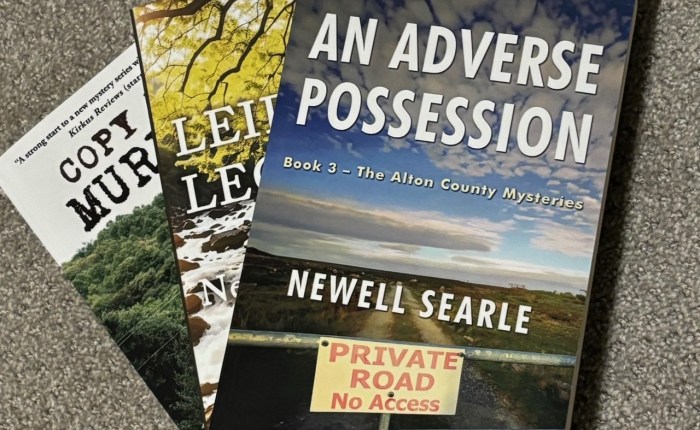
I am happy to announce the publication of AN ADVERSE POSSESION, the third novel in the Alton County Trilogy of mysteries available on Amazon or ordered from your bookstore. Dr. Robert Hartwell returns to Minnesota after years in San Francisco and finds the road to his mineral spring property gated and closed. Cattleman Justin Taylor claims the spring became his when he bought out an adjoining farmer who used Hartwell’s land. The farmer has moved and Hartwell’s lawyer asks Boston Meade to find him. What begins as a small favor becomes a manhunt where adverse possession embodies something more dangerous than Charolais bulls.
Chapter 1
An October rain beat a melancholy patter on the fallen leaves. In the dim light of daybreak, the three-story house loomed dark and angular against the cloudy sky but for a single light in a first-story window. Inside the house, Boston Meade shuffled a half-dozen clippings into a folder marked Runyon Mineral Spring ~ Adverse Possession.
He weighed the clippings in his hand and made a wry face. All I accomplished this summer. A few stories. Dozens of phone calls. Calls that led to more calls. More questions. Fewer answers.
He had readily agreed to help a lawyer find a recently retired farmer in a property dispute. A task of a day or two. After that, he intended to dedicate the summer to drafting a book about a retired forester when he wasn’t writing his syndicated column for American Outlook. Tracking the farmer took time away from the book and the summer’s writing consisted of a half-dozen articles for the Alton County Statesman, southeastern Minnesota’s largest daily. They were collaborations with Ginger O’Meara, the paper’s editor. Though he owned the newspaper, she controlled it because he hired her with a promise to keep his hands off its management. He paused and reread one of his articles:
Robert Hartwell, M.D., of Waterford claims his family has owned the Runyon mineral spring since 1874. According to Justin Taylor the spring became part of his cattle operation when he bought Norman Becker’s farm in May 1985. According to Mr. Taylor, Mr. Becker secured title to the mineral spring because of his continuous use of the tract for 30 years.
Acquiring legal title to another party’s property is possible under Minnesota law through open, continuous and unauthorized use for at least 15 years and spending money to improve it. The process is called adverse possession or squatter’s rights.
After selling his farm to Mr. Taylor, Mr. Becker left the county and his whereabouts are presently unknown. Dr. Hartwell and Mr. Taylor will present their documents of title in district court on July 28. Meanwhile, anyone with information about Mr. Becker’s current location is asked to contact the sheriff.
A brief, economical statement of the case, he thought. Well, most of it, anyway. Good as far as it went. He didn’t foresee what was coming. All his career, he tried to observe, connect and report the facts. Once he agreed to help Morris Isaacs, he couldn’t pretend to be objective. Undesirable but unavoidable. He couldn’t say ‘no’ so, after he said ‘yes,’ he couldn’t back out. Not after the disputed title turned into a case of probable fraud. He realized then he had become an integral part of the story.
He removed the tortoiseshell glasses, pinched the bridge of his Roman nose and then replaced the lenses. Shaking his head in disbelief, he marveled that a dispute over an obscure mineral spring thirty miles away could blow up into a story as complex as some of his international assignments in Saigon, Mexico City and Beirut. Once he got his teeth into this story, he spent all summer chasing it backward and forward in time until it played out.
What mysterious power draws men to a life on the sea or in the soil, he wondered. Not because there weren’t other kinds of work. Certainly not for the money. Farming was dirty, physical labor with great financial risks and damned small rewards. On top of that, the Bureau of Labor Statistics said four of the ten most dangerous jobs were in agriculture. It must be in their soul. Taylor was consumed by his dream of ecological grazing. Hartwell pursued his driving vision of a wellness center. Possessing a piece of land wasn’t like owning a car or even a house. Soil was a living thing and losing the farm brought endless heartache—like a divorce or the death of a child. It was existential. He knew families that had lost their farm after four generations. It was a mortal wound. No man owned a farm, the farm owned him. Boston knew he could say the same for journalism. Poor pay, some danger and a profession hard to quit. He rose from his chair and stretched. Quit bitching. I brought it on myself. No good deed goes unpunished.
He sealed the clippings into a manila envelope and put that into a folder between several others in the filing case. Then he shut the drawer with a feeling of completion. It was nearly 7:00 a.m. and time to make coffee. Then his phone rang. “Meade here,” he said in a soft voice. Then he held his breath as he listened to the caller’s brief message. “Thank you for calling,” he said softly and hung up the phone. Climbing the stairs, he whispered, “Death be not proud, for thou art not so.”
It was only a box in marbled brown Bakelite plastic but it was more formative in the way I perceive and think about the world than any other medium of communications. Radio. Listening. Imagining. I have a blog and a website, I watch some television and read some on-line news, subscribe to magazines and a daily newspaper but it is the radio that makes the biggest impact. That and books. Of all these sources of communication, I rely most on the radio. Why?
When listening, I think much more critically about what I’m hearing than when I receive the same information on television. Radio engages the imagination, the inner person, while television is passive (and there’s science to back this). Perhaps my attachment to radio comes from growing up without television. I was 13 when we got a TV and 14 when I went off to a boarding school without it (but I had my radio) and then on to college. By then, my media habits were settled.
Humans evolved elaborate ways to transmit knowledge through oral communication long before they developed pictures or writing. Indigenous peoples around the world have accurately transmitted, across many generations, factual details of their ancient history that are confirmed by archeology. For centuries, the first books of the Hebrew Scriptures were transmitted orally until they were written . Listening and memory are closely linked. Listening entails making mental pictures that are uniquely personal and aid our ability to recall them. (“The movie isn’t as good as the book.”) The images are eidetic parts of us. I can’t say the same for TV. Nor has the technological capacity to accelerate the rate and volume of communication been matched by a comparable improvement in the quality of what we communicate. In fact, some technology seems to contribute to shorter attention spans and less time to digest what we are hearing.
Call me old fashioned, but the radio—the medium of the spoken word—requires careful listening. It began early for me (and many other children) when my parents read to me before I learned to read. Before that, I “read” books to my sister because I had unconsciously memorized the stories. Later, after I learned to read, Dad and I enjoyed historical novels that he read aloud. (No surprise, perhaps, that I studied to be a historian.)
Unlike the neighboring farm wives, my mother didn’t listen to daytime radio programs and didn’t join in discussions of A Brighter Day, Ma Perkins or The Romance of Helen Trent. She was a librarian cum farmwife, she read or worked crosswords when she had free time.
Dad grew up near Philadelphia during the Depression and the radio was a principle source of entertainment. On the farm at midday dinner, he occasionally listened to the stock market news. No, not the Wall Street market but the livestock market for canners and cutters, barrows and gilts, heifers and steers at the South St. Paul. At harvest time, he followed the status of corn and soybean futures and other information of no interest to me. On Friday nights, he tuned into the boxing matches sponsored by Gillette razor blades. Sometimes he mimed with his fists, a right to the jaw, a left to nose in the rapid-fire broadcasts.
My sister and I usually washed, dried and put away the supper dishes. And if I didn’t have lessons to do, I listened to Dragnet, The FBI in Peace and War, Suspense and Mr. Keen, Tracer of Lost Persons and other showsdepending the day of the week. My Saturdays revolved around broadcasts of Gene Autry’s Melody Ranch and, when I outgrew that, Dad and I listened to Gunsmoke, Perry Mason and Have Gun, Will Travel. On Sunday mornings, we often listened to the Mormon Tabernacle Choir on our drive to church. In the afternoons during winter, my parents listened to classical music concerts by the NBC Orchestra while my sister and I squabbled playing Monopoly. At suppertime, we laughed with Jack Benny and Our Miss Brooks. Even after all these years, I can recall the theme music, the lead in and even bits of episodes.
Listening sharpened my critical thinking. As a writer today, I am still awed at the radio script-writers’ economy in using words to tell a complete story, limn a character and generate humor. Lately, I have begun listening to audiobooks as I drive and notice how the images I “see” in my mind are different from those when I read. It is the same with learning Spanish late in life. If I read “aloud” just under my breath, the ideas and images are clearer than if I only read visually.
Nature and culture have designed us for sophisticated oral communication. To think before we speak. It is still good advice. Listening to the radio helped.
May 30th is the 150th anniversary of celebrating and remembering deceased veterans. It began in 1868 as Decoration Day to commemorate the soldiers slain in the Civil War, and later those lost in the Spanish-American, World War I and World War II. As a child in the 1950’s, we celebrated the day in quaint ways that seem almost relics from another century. I remember Decoration Day (as we called before 1971) as a more solemn and communal occasion than it seems after changing its observance from a fixed date to the end of a three-day weekend on the fourth Monday in May. Along the way, we may lost much of the communal solemnity.
Decoration Day always occurred during the most glorious weather southern Minnesota can offer. A time to honor the dead at a season of new life. The trees were leafed out, wild phlox and geraniums bloomed in the woodlands, orioles and meadowlarks trilled from the fencerows and cottonwood groves. This day meant two things important to this schoolboy: my little sister’s birthday and the last week of classes before summer vacation.
My memories of our small-town Decoration Day celebration began with the sale of buddy poppies in the Rexall drug store, the Ben Franklin dime store and other shops. Veterans of World War II sold them to raise money for comrades disabled in conflict. At the age of 10 or 11, I couldn’t explain why I bought one except everyone expected me to. Like going to church, I did it because–well–everyone else did it. It was part of being an American to wear this icon of remembrance and sacrifice.
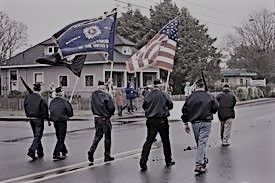
VFW Color Guard
On this day, the merchants of Janesville hung out flags and there was a parade led by the VFW honor guard carrying the American flag followed by the drill team marching along, the sun gleaming off their chromed helmets and the barrels of the Springfield rifles on their shoulders. Behind them came VWF Women’s Auxiliary and the high school band playing patriotic songs for this solemn occasion. If there were speeches, I don’t recall them but they weren’t things boys remembered.
Decoration Day meant a trip to the Janesville Cemetery on a knoll a mile east of town. In the days leading up to the celebration, families raked the ground over the graves, mowed the new grass and decorated the headstones with flowers (real or made of paper), and small American flags. Our family went to the cemetery with Aunt Faith to visit her father’s grave. On the headstones I saw many familiar surnames, the ancestors of my classmates and school chums. Even as a boy, I felt a palpable but still inexpressible link connecting me to those lying beneath the headstones.
Almost every man I knew when I was a boy had served in World War II in some capacity. Uncle Walter, our neighbor’s brother, lost an eye fighting the Japanese. Our dentist served in the cavalry (without horses), mother’s cousin was a B-24 crew chief and my uncle Rob ran an Air Force fighter communications network in China.
Mrs. Wegge, our sixth-grade teacher, prepared us for Decoration Day. I recall learning the first stanza of the famous poem, In Flanders’ Fields, written in 1915 by a Canadian soldier amazed to see the brilliant red flowers blooming in the hellish no-man’s land churned and pocked by shells:
In Flanders fields the poppies blow
Between the crosses, row on row,
That mark our place; and in the sky
The larks, still bravely singing, fly
Scarce heard amid the guns below.
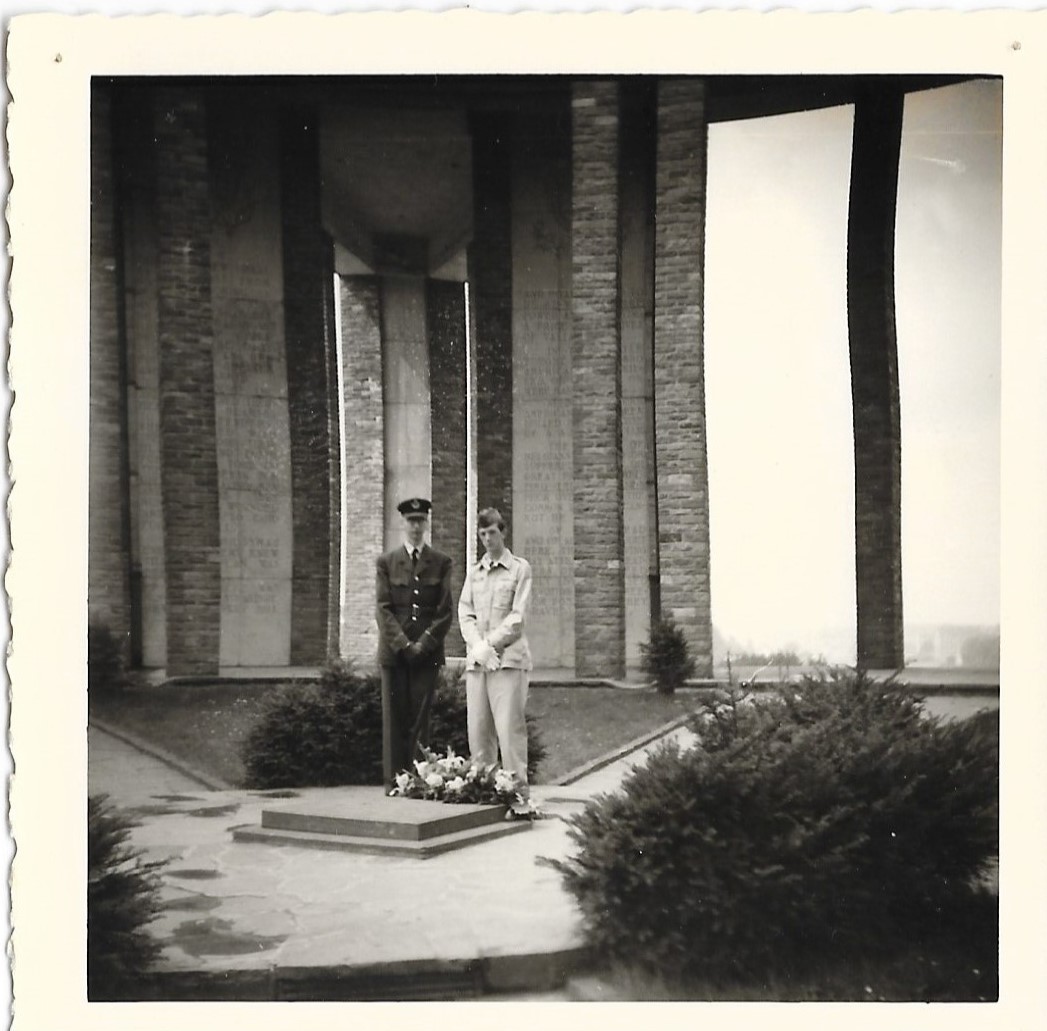
Belgium: Tomb of the Unknown
The poem’s elegiac meaning made little impression on me until the summer of 1961, after I graduated from high school. I visited Flanders in Belgium as part of an air cadet exchange with other NATO countries. Belgium is one tenth the size of Minnesota and a battleground during much of its history. Flanders lies north of Brussels, Waterloo, the site of Napoleon’s defeat in 1815, lies just south of it and Bastogne, a major battle of World War II, lies to the east. During that month, our Belgian Air Force hosts showed us historic sites from many wars. We laid a wreath at the tomb of the unknown and our contingent sat atop the hull of a tank destroyed in the battle for Bastogne, sixteen years before. I returned home from Belgium amid a national mobilization for conflict with the Soviet Union over access to Berlin. War seemed very close.
The grief of the Civil War, the Great War and World War II touched virtually every American community and nearly everyone knew of a family that had lost someone. Congressional declarations of war and shared sorrow once mobilized the nation into a common effort. For 30 years, compulsory military service gave young men a common and transformative experience and every family a direct stake in going to war or opposing it.
John F. Kennedy’s call to “ask what you can do for your country” has lapsed with time. The abolition of the draft and reliance on a wholly professional military has made serving one’s country an option, a choice but not a shared responsibility. I fear this change has made us numb to the conflicts ostensibly waged for our protection. And with this disconnection, we may lose our understanding of Memorial or Decoration Day as a time of comunal remembrance.
In this era of on-line sales, after more than a century as retailing behemoths, the business press predicts the imminent demise of Sears-Roebuck & Company and JC Penny. Both are institutions founded in an age before rural free delivery, widespread telephone use and, certainly, the internet. These mail order hosues were fixtures in thousands of small towns along with the Ben Franklin five and dime, Rexall Drug, A & W Root Beer stands and Dairy Queen.
Growing up on a farm in the 1950’s, the Sears-Roebuck catalogue was definitely a “wish book.” With more than 500 pages, my sister and I would spend rainy afternoons pouring over the pages, selecting things we wanted but knew we couldn’t afford. One can dream. This catalogue was the Amazon.com of its day.
Every summer, Mom and I riffled through the catalogue, selecting the clothing for school in the fall and winter. I wore Roebuck jeans that didn’t have the same cachet as Levi’s. Of course, I had western-style shirts with pearl-like snaps instead of buttons. But no cowboy boots. Not practical, especially when my growth spurt started and shoe sizes expanded. Then it was my sister’s turn to pick her clothes. Before ordering, my sister and I stood straight as our mother measured our height, waist and chest to get the right size with room to grow during the year.
One of us carried the order in its envelope up the hill to the mailbox. Then we waited. And waited. And waited until the mailman blew his horn and dropped a box by the mailbox. Our clothes! The box was usually so big we had to fetch it in the pick-up. One by one, we took out the items. Ah, the aroma of new clothes. Then we tried on each item to be sure of the fit but we couldn’t wear anything until the first day of school. This was like an early Christmas!
You could buy anything from Sears & Roebuck—anything! The catalogue carried hardware, furniture, Kenmore appliances, Craftsman tools, sewing machines and even kits for houses. From 1908 until 1942, Sears sold pre-fab houses. The parts for the house were shipped in boxcars. Each house weighed up to 25 tons and contained more than 30,000 parts. Pre-fabs were cheaper to build and accommodated modern conveniences like central heating, electricity and plumbing. As I look at old catalogues (on-line) with pictures of the Sears houses, the designs look familiar and I wonder how many of those houses I have visited without knowing they were pre-fab? At least one house on a neighboring farm appears to a Sears house.
For many years, we didn’t buy a lot in the stores because it was cheaper to order goods from the Sears-Roebuck catalogue. We did it for the same reason we order books, clothing, cameras, yarn and household good from Amazon.
There is a cycle to this, I think. The Sears catalogue business offered rural residents an alternative to the narrower selection and higher priced goods of general stores. As the Sears business grew, and the population became more urbanized, it invested heavily in stores at shopping malls after World War II while its chief competitor, Montgomery Ward, did not. Sears continued to grow and diversify. It became the nation’s largest retailer until the 1980’s with the rise of Walmart. Since then, its fortunes have declined in the face of discounters. Now Target and Walmart are hard-pressed by competition from Amazon.
A Sears catalogue became archaic almost as soon as it left the press because the next wish book was in preparation. Many a catalogue ended its life in the little house with a crescent-moon on the door. Our neighbors didn’t have an indoor toilet until a decade after they bought a black and white television to watch wrasslin’ matches between Hardboiled Hagerty and Farmer Marlin. For toilet paper, they used last year’s Sears catalogue. A sad end to a volume of wishes. As I said, things go in cycles and maybe the antidote to Amazon will be the ‘buy local’ movement. Time will tell.







 Growing up on a farm in the 1950’s, the Sears-Roebuck catalogue was definitely a “wish book.” With more than 500 pages, my sister and I would spend rainy afternoons pouring over the pages, selecting things we wanted but knew we couldn’t afford. One can dream. This catalogue was the Amazon.com of its day.
  by the mailbox. Our clothes! The box was usually so big we had to fetch it in the pick-up. One by one, we took out the items. Ah, the aroma of new clothes. Then we tried on each item to be sure of the fit but we couldn’t wear anything until the first day of school. This was like an early Christmas!
 For many years, we didn’t buy a lot in the stores because it was cheaper to order goods from the Sears-Roebuck catalogue. We did it for the same reason we order books, clothing, cameras, yarn and household good from Amazon.
  R. Newell Searle